
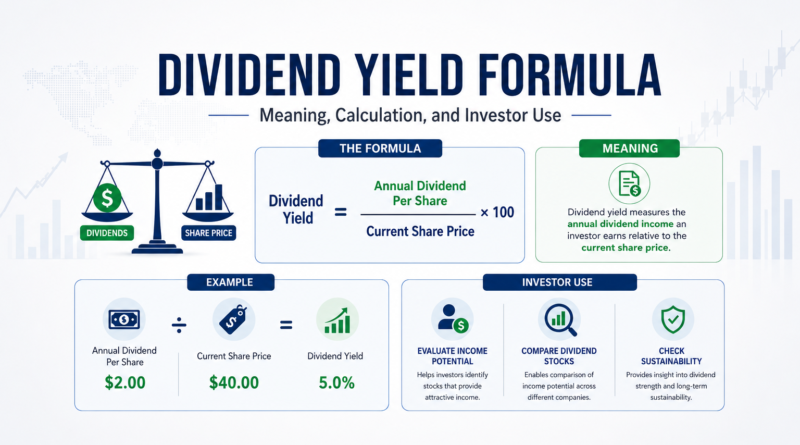
Dividend Yield Formula: Meaning, Calculation, and Investor Use
Dividend yield is a financial ratio that compares a company’s annual dividend per share with its stock price. The dividend yield formula helps investors estimate income return from dividends. Investors use dividend yield to review income potential, compare dividend-paying stocks, and evaluate whether a dividend is attractive, sustainable, or risky.
What Is Dividend Yield?
Dividend yield measures how much annual dividend income an investor may receive compared with the current share price of a stock. It is usually shown as a percentage.
In simple terms, dividend yield answers this question: how much dividend income does the stock pay relative to the price investors pay for one share?
For example, if a stock trades at $50 and pays $2 per share in annual dividends, its dividend yield is 4%. This means the annual dividend equals 4% of the share price.
Dividend yield is commonly used in stock analysis, financial ratio analysis, income investing, and dividend portfolio review. It is especially important for investors who care about cash income from stocks, not only share price growth.
Dividend Yield Formula
The basic dividend yield formula is:
Dividend Yield = Annual Dividend Per Share / Current Share Price
To show the result as a percentage:
Dividend Yield = (Annual Dividend Per Share / Current Share Price) × 100
For example, if a company pays $1.50 per share in annual dividends and the stock price is $30, the dividend yield is:
Dividend Yield = ($1.50 / $30) × 100 = 5%
This means the stock pays annual dividends equal to 5% of its current share price.
The formula is simple, but the interpretation requires context. A high dividend yield may look attractive, but it can also signal that the market expects the dividend to be reduced.
Dividend Yield Meaning
Dividend yield meaning depends on the relationship between dividend payments and stock price.
A higher dividend yield means the dividend is large compared with the share price. A lower dividend yield means the dividend is smaller compared with the share price.
However, dividend yield can change for two different reasons:
- the dividend amount changes;
- the stock price changes.
If the dividend stays the same but the stock price falls, dividend yield rises. This can make a stock look more attractive, but it may also reflect business risk or investor concern.
If the stock price rises while the dividend stays the same, dividend yield falls. This does not always mean the company is weaker. It may simply mean investors are paying a higher price for the stock.
What Is a Dividend Yield?
A dividend yield is the percentage return an investor may receive from annual dividends relative to the current stock price.
For example, a 3% dividend yield means the annual dividend equals 3% of the share price. If an investor buys a stock at $100 and the annual dividend is $3 per share, the dividend yield is 3%.
Dividend yield does not include possible capital gains or losses. If the stock price rises or falls after purchase, the investor’s total return will be different from the dividend yield alone.
That is why dividend yield should be viewed as one part of stock analysis, not the full investment result.
How to Calculate Dividend Yield
To calculate dividend yield, follow three steps.
Step 1: Find Annual Dividend Per Share
Annual dividend per share is the total dividend paid per share over one year.
If a company pays quarterly dividends, multiply the quarterly dividend by four.
For example, if a company pays $0.40 per share each quarter:
Annual Dividend Per Share = $0.40 × 4 = $1.60
If the company pays monthly dividends, multiply the monthly dividend by twelve.
Step 2: Find the Current Share Price
The current share price is the market price of one share. This number changes as the stock trades.
Dividend yield is usually calculated using the current share price. Some investors may also calculate yield based on their purchase price, which is sometimes called yield on cost. However, standard dividend yield uses the current market price.
Step 3: Divide Dividend by Share Price
After finding annual dividend per share and current share price, divide the dividend by the share price and multiply by 100.
For example:
Dividend Yield = ($2.00 / $50) × 100 = 4%
The stock has a dividend yield of 4%.
Dividend Yield Calculation Example
Imagine a company reports the following numbers:
| Item | Amount |
|---|---|
| Quarterly dividend per share | $0.50 |
| Annual dividend per share | $2.00 |
| Current share price | $40 |
Now calculate dividend yield:
Dividend Yield = ($2.00 / $40) × 100 = 5%
The company’s dividend yield is 5%. This means an investor buying the stock at $40 would receive annual dividend income equal to 5% of the purchase price, assuming the dividend stays the same.
Now compare that with another company:
| Company | Annual Dividend | Share Price | Dividend Yield |
|---|---|---|---|
| Company A | $2.00 | $40 | 5% |
| Company B | $1.50 | $25 | 6% |
Company B has a smaller dividend per share, but its dividend yield is higher because its share price is lower.
Why Dividend Yield Matters to Investors
Dividend yield matters because it helps investors evaluate income potential.
Some investors buy stocks mainly for long-term price growth. Others also want regular dividend income. Dividend yield helps compare the income return from different dividend-paying stocks.
Investors use dividend yield to analyze:
- dividend income potential;
- stock income compared with price;
- dividend-paying companies;
- income portfolio opportunities;
- valuation context;
- dividend sustainability risk.
Dividend yield is especially useful when comparing companies in the same industry. Comparing dividend yield across very different industries can be misleading because dividend policies vary widely.
Dividend Yield in Financial Ratio Analysis
Dividend yield is a financial ratio because it compares one financial number with another. It connects dividend income with stock price.
Dividend yield is often reviewed with other financial ratios:
| Ratio | What It Helps Analyze |
|---|---|
| Dividend yield | Dividend income compared with share price |
| Earnings per share | Profit available for each common share |
| Price to earnings ratio | Stock valuation compared with EPS |
| Payout ratio | Dividend payments compared with earnings |
Dividend yield is useful, but it should not be used alone. A high dividend yield may look attractive, but investors should check whether the company can actually support the dividend.
Dividend Yield and Earnings Per Share
Earnings per share, or EPS, matters because dividends are often paid from company earnings.
If a company pays dividends that are much higher than its earnings per share, the dividend may be difficult to sustain. A dividend can sometimes be supported by cash reserves or temporary financing, but that may not be reliable over the long term.
For example, if a company earns $3.00 per share and pays $1.50 in annual dividends, the dividend may appear more sustainable than a company earning $1.00 per share and paying $1.50 in dividends.
Investors often compare dividend yield with earnings per share to understand whether dividend income is supported by business profitability.
Dividend Yield and Price to Earnings Ratio
Dividend yield and price to earnings ratio are both useful in stock analysis, but they answer different questions.
Dividend yield focuses on income. It shows annual dividend income compared with stock price.
Price to earnings ratio focuses on valuation. It compares stock price with earnings per share.
A stock may have a high dividend yield and a low P/E ratio, which may suggest a cheaper income stock. But it may also suggest that investors are worried about business risk, earnings decline, or a possible dividend cut.
A stock may have a low dividend yield and high P/E ratio if investors expect strong growth. In that case, the company may be valued more for future earnings growth than for current dividend income.
What Is a Good Dividend Yield?
A good dividend yield depends on the company, industry, dividend history, interest rate environment, and business risk.
There is no single dividend yield that is good for every stock. A 2% yield may be reasonable for a stable company with strong dividend growth. A 7% yield may look attractive but could be risky if the company’s earnings and cash flow are weak.
Investors often look for dividend yields that are:
- supported by earnings;
- supported by free cash flow;
- consistent with the company’s history;
- reasonable for the industry;
- not caused only by a sharp stock price decline;
- paired with a sustainable dividend policy.
A good dividend yield is not only high. It should also be sustainable.
High Dividend Yield
A high dividend yield means the annual dividend is large compared with the stock price.
A high dividend yield may suggest:
- strong income potential;
- a mature dividend-paying company;
- a stock price that has fallen;
- investor concern about future earnings;
- a possible dividend cut risk.
This is why high dividend yield can be both attractive and dangerous. Investors may like the income, but they need to understand why the yield is high.
If the yield is high because the company has stable earnings and a reasonable dividend policy, it may be useful. If the yield is high because the share price collapsed due to business problems, it may be a warning sign.
Low Dividend Yield
A low dividend yield means the annual dividend is small compared with the stock price.
A low dividend yield may happen because:
- the company pays a small dividend;
- the share price has increased;
- the company reinvests profits for growth;
- investors expect future earnings growth;
- the business is not focused on dividends.
Low dividend yield is not automatically bad. Some companies pay low dividends because they use cash to expand, invest in research, buy back shares, or strengthen the business.
Growth companies may have low or no dividend yield because they focus on reinvestment rather than income distribution.
Dividend Yield vs Dividend Growth
Dividend yield and dividend growth are related, but they are not the same.
Dividend yield shows current income compared with stock price. Dividend growth shows whether the dividend is increasing over time.
| Metric | Main Question |
|---|---|
| Dividend yield | How much income does the stock pay now? |
| Dividend growth | Is the dividend increasing over time? |
| Dividend sustainability | Can the company keep paying it? |
A stock with a high current yield but no dividend growth may be less attractive than a stock with a moderate yield and steady dividend increases.
Investors often review both current yield and dividend growth history.
Dividend Yield and Payout Ratio
Dividend yield tells investors how much dividend income they may receive compared with the stock price. Payout ratio tells investors how much of company earnings are paid as dividends.
The payout ratio formula is:
Payout Ratio = Dividends Per Share / Earnings Per Share
If a company pays $2 in dividends and earns $4 per share, the payout ratio is 50%.
A very high payout ratio can be a warning sign because the company may not retain enough earnings for reinvestment, debt reduction, or difficult periods.
Dividend yield is more useful when reviewed together with payout ratio.
Investors often review the dividend payout ratio to see whether dividend income is supported by company earnings.
Dividend Yield and Cash Flow
Cash flow matters because dividends are paid in cash. A company may report accounting earnings, but if cash flow is weak, dividend sustainability may be questionable.
Investors often review free cash flow because it shows cash available after operating needs and capital expenditures. If free cash flow consistently supports dividend payments, the dividend may be more reliable.
If a company pays dividends while free cash flow is weak or negative, investors should ask how the dividend is being funded.
A dividend supported by strong cash flow is usually more reliable than a dividend supported mainly by debt or asset sales.
Practical Note
A high dividend yield should always be checked against the reason behind the yield. If the yield is high because the dividend is stable and the stock is undervalued, it may be attractive. If the yield is high because the share price is falling due to weak fundamentals, it may be a dividend trap.
Dividend Trap Risk
A dividend trap happens when a stock looks attractive because of a high dividend yield, but the dividend is not sustainable.
This can happen when the stock price falls sharply. Since dividend yield uses share price in the denominator, a falling share price can make the yield rise quickly.
For example, if a stock pays $2 per year and trades at $50, the yield is 4%. If the stock falls to $25 and the dividend has not changed yet, the yield becomes 8%.
That higher yield may look attractive, but the falling stock price may signal that investors expect weaker earnings or a dividend cut.
Common Dividend Yield Mistakes
One common mistake is assuming that the highest dividend yield is always best. A very high yield can signal risk.
Another mistake is ignoring dividend sustainability. Investors should check earnings, cash flow, debt, and payout ratio.
A third mistake is comparing dividend yields across unrelated industries. Some sectors naturally pay higher dividends, while others reinvest more cash into growth.
A fourth mistake is ignoring total return. Dividend income is only one part of investment performance. Stock price changes also matter.
A fifth mistake is focusing only on current yield without reviewing dividend history. A company with a long record of stable or growing dividends may be different from a company with an unstable dividend policy.
Dividend Yield Red Flags
Important dividend yield red flags include:
- dividend yield rises because the stock price falls sharply;
- payout ratio is very high;
- dividends exceed earnings per share;
- dividends exceed free cash flow;
- debt is rising while dividends remain high;
- dividend growth stops or reverses;
- management warns about weaker earnings;
- cash flow becomes inconsistent.
These signals do not automatically mean the dividend will be cut, but they show that deeper financial statement analysis is needed.
How Investors Use Dividend Yield
Investors use dividend yield to evaluate income potential, compare dividend stocks, and review whether a stock may fit an income strategy.
A practical dividend yield review may include these questions:
- What is the current dividend yield?
- Is the yield high or low compared with industry peers?
- Is the dividend supported by earnings per share?
- Is the dividend supported by free cash flow?
- Has the company raised, maintained, or cut dividends?
- Is the payout ratio reasonable?
- Is debt pressure increasing?
- Is the stock price falling because of business weakness?
Dividend yield becomes more useful when combined with financial analysis rather than treated as a single buying signal.
Dividend Yield in Financial Statement Analysis
Dividend yield belongs in financial statement analysis because dividend payments depend on business strength.
Investors should review the income statement to understand earnings. They should review the cash flow statement to see whether the company produces enough cash. They should review the balance sheet to understand debt levels and financial flexibility.
Dividend yield analysis may include:
- earnings per share;
- free cash flow;
- payout ratio;
- debt to equity ratio;
- profit margins;
- price to earnings ratio;
- dividend history;
- revenue stability.
This broader view helps investors avoid judging a dividend stock only by yield.
Limitations of Dividend Yield
Dividend yield is useful, but it has limitations.
Dividend yield does not show whether the dividend is safe. It does not show whether earnings are stable. It does not explain cash flow quality. It does not include capital gains or losses. It can also change quickly when the stock price moves.
Dividend yield can be misleading when a company’s stock price falls sharply. The yield may rise before the company cuts the dividend.
For these reasons, dividend yield should be used as a starting point, not a final conclusion.
Key Takeaways
Dividend yield measures annual dividend income compared with the current share price.
The dividend yield formula is annual dividend per share divided by current share price.
A high dividend yield may be attractive, but it can also signal risk.
A low dividend yield may be normal for growth companies or stocks with rising share prices.
Dividend yield is most useful when reviewed with earnings per share, free cash flow, payout ratio, debt, dividend history, and price to earnings ratio.
Investors should avoid using dividend yield alone because it does not prove dividend safety.
FAQ
What is dividend yield?
Dividend yield is a financial ratio that compares annual dividend per share with current share price. It shows how much dividend income a stock pays relative to its price.
What is the dividend yield formula?
The dividend yield formula is annual dividend per share divided by current share price. The result is usually multiplied by 100 to show a percentage.
What is a dividend yield?
A dividend yield is the percentage income return from dividends compared with the stock price. For example, a 4% dividend yield means annual dividends equal 4% of the share price.
How do you calculate dividend yield?
To calculate dividend yield, divide annual dividend per share by current share price and multiply by 100.
Is a high dividend yield good?
A high dividend yield can be good if it is supported by earnings and cash flow. However, a very high yield can also be a warning sign if the stock price has fallen sharply or the dividend is not sustainable.
Is a low dividend yield bad?
A low dividend yield is not always bad. Some companies pay small dividends because they reinvest profits for growth or because the stock price has increased.
What causes dividend yield to increase?
Dividend yield can increase if the company raises its dividend or if the stock price falls. Investors should check which reason caused the increase.
What is a dividend trap?
A dividend trap is a stock that looks attractive because of a high dividend yield, but the dividend may be unsafe. This often happens when the stock price falls because of weak business fundamentals.
Why do investors use dividend yield?
Investors use dividend yield to compare dividend income potential, review income stocks, and evaluate whether a dividend-paying stock fits their investment goals.
Final Summary
Dividend yield is a useful financial ratio for investors who want to understand dividend income compared with stock price. The formula is simple, but interpretation requires careful analysis. Investors should review dividend yield together with earnings per share, cash flow, payout ratio, debt levels, dividend history, and price to earnings ratio before judging whether a dividend stock is attractive or risky.