
EBITDA Margin Formula: Meaning, Calculation, and Profitability Analysis
EBITDA margin is a profitability ratio that shows operating earnings before interest, taxes, depreciation, and amortization as a percentage of revenue. The formula helps investors understand how much pre-tax operating profit a company generates before certain financing and accounting effects. A higher margin may suggest stronger operating profitability, but it should not be used alone.
What Is EBITDA Margin?
This profitability ratio measures how much EBITDA a company generates from each dollar of revenue. It is commonly used in profitability analysis because it focuses on earnings before financing costs, tax effects, depreciation, and amortization.
In simple terms, the ratio answers this question: how much operating profit does the company generate before certain financing and accounting expenses for every dollar of sales?
For example, if a company has revenue of $1,000,000 and EBITDA of $250,000, the margin is 25%. This means the company keeps 25 cents of EBITDA for every $1 of revenue.
Analysts often use this metric to compare operating profitability across companies, especially when business models have different debt levels, tax structures, or asset bases.
EBITDA Meaning
The term EBITDA means earnings before interest, taxes, depreciation, and amortization.
In financial analysis, this metric helps investors review profitability before financing costs, tax effects, and certain non-cash accounting expenses.
The term is used to estimate a company’s operating profitability before certain non-operating and non-cash expenses. It can help investors focus on core business performance before financing decisions and accounting charges.
The full meaning is:
Earnings Before Interest, Taxes, Depreciation, and Amortization
Each part matters:
- Interest is excluded because it relates to financing choices.
- Taxes are excluded because tax rates and tax situations can differ.
- Depreciation is excluded because it is a non-cash accounting expense tied to physical assets.
- Amortization is excluded because it is a non-cash accounting expense tied to intangible assets.
EBITDA does not mean pure cash flow. It is not the same as free cash flow. It is a profitability measure that can be useful, but it has limitations.
What Is EBITDA?
EBITDA is a financial metric that starts with earnings and adds back interest, taxes, depreciation, and amortization.
Investors use it to review how much profit a company generates before the impact of financing structure, tax rules, and certain accounting expenses.
For example, two companies may have similar operating performance but different interest expenses because one company uses more debt. This metric can help compare operating performance before interest costs.
However, it should not be treated as a complete measure of business health. It does not include capital expenditures, working capital needs, debt repayment, or all cash obligations.
EBITDA Formula
The common EBITDA formula is:
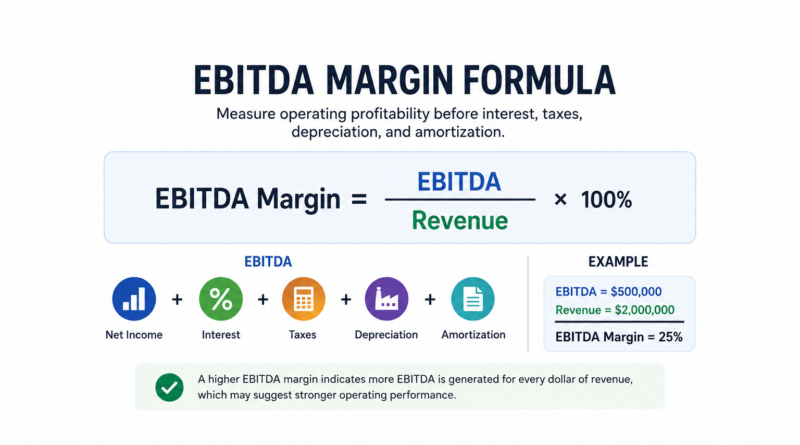
EBITDA = Net Income + Interest + Taxes + Depreciation + Amortization
Another version starts from operating income:
EBITDA = Operating Income + Depreciation + Amortization
Both formulas are used in financial statement analysis. The correct version depends on how the company reports its income statement.
For example, if a company reports:
- Net income: $120,000
- Interest expense: $20,000
- Taxes: $30,000
- Depreciation: $40,000
- Amortization: $10,000
Then:
EBITDA = $120,000 + $20,000 + $30,000 + $40,000 + $10,000 = $220,000
This means the company generated $220,000 in EBITDA during the period.
EBITDA Margin Formula
The EBITDA margin formula is:
EBITDA Margin = EBITDA / Revenue
To show the result as a percentage:
EBITDA Margin = (EBITDA / Revenue) × 100
For example, if EBITDA is $220,000 and revenue is $1,000,000:
EBITDA Margin = ($220,000 / $1,000,000) × 100 = 22%
This means the company generated EBITDA equal to 22% of revenue.
The formula is useful because it turns EBITDA into a percentage. That makes it easier to compare companies of different sizes.
EBITDA Margin Meaning
EBITDA margin meaning depends on how much EBITDA the company produces relative to revenue.
A higher margin usually means the company keeps more operating profit before interest, taxes, depreciation, and amortization. This may suggest stronger pricing power, better cost control, efficient operations, or a more profitable business model.
A lower margin may suggest weaker profitability, higher operating costs, pricing pressure, or less efficient operations.
However, this ratio should always be interpreted with context. Some industries naturally have higher margins than others. A software company may have a higher percentage than a retailer or manufacturer because their cost structures are different.
How to Calculate EBITDA Margin
To calculate EBITDA margin, follow three steps.
Step 1: Find Revenue
Revenue is the total amount a company earns from selling goods or services before expenses are deducted. It appears at the top of the income statement.
Revenue is important because the calculation measures EBITDA as a percentage of revenue.
Step 2: Find EBITDA
EBITDA may be reported directly by the company, or it may need to be calculated.
A common formula is:
EBITDA = Net Income + Interest + Taxes + Depreciation + Amortization
Investors should check whether the company reports standard EBITDA or adjusted EBITDA. Adjusted figures may exclude additional items, which can make comparison more difficult.
Step 3: Divide EBITDA by Revenue
After finding EBITDA and revenue, divide EBITDA by revenue and multiply by 100.
For example:
EBITDA Margin = ($300,000 / $1,500,000) × 100 = 20%
The company has a margin of 20%.
Calculation Example
Imagine a company reports the following numbers:
| Item | Amount |
|---|---|
| Revenue | $2,000,000 |
| EBITDA | $500,000 |
| Margin | 25% |
The calculation is:
EBITDA Margin = ($500,000 / $2,000,000) × 100 = 25%
This means the company generates 25 cents of EBITDA for every $1 of revenue.
Now compare two companies:
| Company | Revenue | EBITDA | Margin |
|---|---|---|---|
| Company A | $2,000,000 | $500,000 | 25% |
| Company B | $5,000,000 | $750,000 | 15% |
Company B has higher EBITDA in dollar terms, but Company A has the higher margin. This shows why margin analysis matters. The larger company is not always the more profitable company relative to revenue.
Why This Margin Matters
This margin matters because it helps investors and analysts evaluate operating profitability before financing and accounting effects.
Investors use it to analyze:
- profitability before interest and taxes;
- cost efficiency;
- operating performance;
- business model strength;
- margin trends;
- peer comparison;
- financial statement analysis;
- profitability analysis.
The ratio can be especially useful when comparing companies with different debt levels or depreciation policies. It helps focus on operating earnings before some items that may vary because of financing or accounting choices.
Role in Profitability Analysis
This metric is part of profitability analysis because it measures profit relative to revenue.
A company with a rising margin may be improving its cost structure, increasing prices, scaling operations, or managing expenses more efficiently.
A company with a falling margin may be facing cost inflation, pricing pressure, weaker demand, or operational inefficiency.
Profitability analysis is stronger when this ratio is reviewed with other profit margin metrics, such as gross profit margin, operating margin, and net profit margin.
EBITDA Margin vs Operating Margin
EBITDA margin and operating margin are related, but they are not the same.
Operating margin uses operating income. EBITDA-based margin uses EBITDA.
| Metric | Formula | Main Focus |
|---|---|---|
| EBITDA margin | EBITDA / Revenue | Profit before interest, taxes, depreciation, and amortization |
| Operating margin | Operating income / Revenue | Profit after operating expenses, including depreciation and amortization |
The operating margin formula is:
Operating Margin = Operating Income / Revenue
A similar formula is used for operating profit margin:
Operating Profit Margin = Operating Profit / Revenue
In most cases, EBITDA-based margin is higher than operating margin because EBITDA adds back depreciation and amortization.
EBITDA Margin vs Profit Margin
These margins measure different layers of profitability.
Profit margin formula can refer to several types of margin, including gross profit margin, operating profit margin, and net profit margin.
Net profit margin measures net income as a percentage of revenue:
Net Profit Margin = Net Income / Revenue
EBITDA-based margin excludes interest, taxes, depreciation, and amortization. Net profit margin includes those items.
This means the EBITDA version can make a company look more profitable than net profit margin. That is not always wrong, but investors should understand what is being excluded.
EBITDA Margin vs Gross Profit Margin
Gross profit margin measures gross profit as a percentage of revenue. It focuses on revenue after direct costs of goods sold.
The EBITDA-based margin goes further down the income statement. It considers more operating expenses, but excludes depreciation and amortization.
Gross profit margin is useful for analyzing pricing and direct production costs. EBITDA-based analysis is useful for reviewing broader operating profitability before financing and certain accounting expenses.
A company may have a strong gross profit margin but weak EBITDA-based profitability if operating expenses are too high.
What Is a Good EBITDA Margin?
A good EBITDA margin depends on the industry, business model, company size, growth stage, and cost structure.
There is no single margin level that is good for every company.
A mature software company may have a high margin because its incremental costs can be low. A retailer may have a lower figure because inventory, labor, and store costs can be significant. A manufacturer may have different margins depending on production costs, scale, and capital intensity.
Investors usually compare the ratio with:
- industry peers;
- the company’s historical margin;
- revenue growth;
- operating margin;
- net profit margin;
- free cash flow;
- debt levels;
- interest coverage.
A good margin is one that is strong relative to the company’s industry and sustainable over time.
High EBITDA Margin
A high EBITDA margin means the company generates more EBITDA from each dollar of revenue.
A high ratio may suggest:
- strong pricing power;
- efficient cost structure;
- scalable business model;
- disciplined expense control;
- strong operating performance;
- attractive profitability.
However, a high ratio does not automatically mean the company is a low-risk investment. The company may still have high debt, weak cash flow, large capital expenditure needs, or expensive valuation.
Investors should review this margin together with free cash flow and balance sheet strength.
Low EBITDA Margin
A low EBITDA margin means the company generates less EBITDA from each dollar of revenue.
This may suggest high operating costs, weak pricing power, competitive pressure, inefficient operations, a low-margin business model, or early-stage growth spending.
However, a low margin is not always bad. Some companies accept lower margins while they invest in growth, expand market share, or build infrastructure.
The key question is whether the margin can improve over time.
Financial Statement Analysis
This ratio belongs in financial statement analysis because it uses income statement data.
Investors should review revenue, operating expenses, depreciation, amortization, interest expense, taxes, and net income. EBITDA-based analysis can help isolate a version of operating profitability, but it should not replace full financial statement review.
A complete analysis may include:
- revenue growth;
- gross profit margin;
- operating margin;
- EBITDA margin;
- net profit margin;
- free cash flow;
- debt to equity ratio;
- interest coverage ratio.
This wider view helps investors understand whether operating profitability is supported by real business strength.
EBITDA Margin and Free Cash Flow
EBITDA margin is not the same as free cash flow.
This profitability metric excludes depreciation and amortization, but it does not subtract capital expenditures. That matters because companies with heavy asset needs may need to spend significant cash to maintain equipment, property, factories, or infrastructure.
As a result, a company can report strong EBITDA-based profitability while still producing weak free cash flow if capital expenditures are high.
This is why investors should compare the margin with free cash flow. The margin shows operating profitability before some charges. Free cash flow shows cash remaining after operating needs and capital investment.
EBITDA Margin and Interest Coverage
This margin can also help investors understand debt risk, but it does not directly measure interest payment capacity.
Interest coverage ratio compares EBIT with interest expense. EBITDA-based margin measures EBITDA as a percentage of revenue.
A company with strong operating profitability may have more earnings to support debt costs. However, if debt is very high, interest expense may still create pressure.
Investors often review this ratio together with interest coverage ratio when analyzing companies with financial leverage.
Adjusted EBITDA and EBITDA Margin
Adjusted EBITDA is EBITDA after management removes certain items it considers unusual, non-recurring, or outside normal operations.
This adjusted metric can be useful when it removes genuinely unusual items. However, it can also be risky if too many expenses are excluded.
For example, a company may adjust for restructuring costs, acquisition costs, stock-based compensation, or other items. If these costs happen repeatedly, adjusted EBITDA may overstate normal profitability.
Investors should check what adjustments are included before relying on adjusted EBITDA margin.
Practical Note
This margin is most useful when compared with similar companies in the same industry. Comparing it across unrelated industries can lead to weak conclusions because cost structures, capital intensity, and accounting patterns can be very different.
Common EBITDA Margin Mistakes
One common mistake is treating this margin as cash flow. EBITDA is not free cash flow because it does not subtract capital expenditures, working capital needs, or debt repayment.
Another mistake is assuming a high margin means the company is financially safe. A company can have strong EBITDA-based profitability and still have high leverage or weak cash flow.
A third mistake is comparing margins across very different industries. Different business models naturally produce different profitability levels.
A fourth mistake is ignoring depreciation and amortization completely. These expenses may be non-cash in the current period, but they often reflect real asset costs over time.
A fifth mistake is accepting adjusted EBITDA without reviewing the adjustments.
EBITDA Margin Red Flags
Important red flags include:
- the margin rises while free cash flow is weak;
- adjusted EBITDA excludes recurring costs;
- revenue falls but the margin appears stable only because of cost cuts;
- depreciation and amortization are large compared with earnings;
- debt rises while profitability is flat;
- operating margin is much weaker than EBITDA-based margin;
- capital expenditures are high;
- management focuses only on EBITDA and ignores net income or cash flow.
These red flags do not automatically mean a company is weak, but they show that deeper financial analysis is needed.
When EBITDA Margin Can Be Misleading
EBITDA-based margin can be misleading when a company has large capital expenditure needs. The ratio adds back depreciation and amortization, but the business may still need to spend cash to maintain or replace assets.
It can also be misleading when companies use aggressive adjustments. Adjusted EBITDA may make profitability look stronger than it really is if recurring expenses are removed.
This metric can also hide debt pressure because it excludes interest expense. A company may have strong operating profitability but still struggle with high interest costs.
For these reasons, the ratio should be used with operating margin, net profit margin, free cash flow, and leverage ratios.
How Investors Use EBITDA Margin
Investors use EBITDA margin to evaluate operating profitability and compare companies.
A practical review may include these questions:
- What is the current margin?
- Is it rising or falling?
- How does it compare with industry peers?
- How does it compare with operating margin?
- Is free cash flow also strong?
- Are adjustments reasonable?
- Is revenue growing?
- Is debt increasing?
- Is interest coverage strong?
This process helps investors avoid relying on one profitability measure alone.
Limitations of EBITDA Margin
EBITDA margin is useful, but it has limitations.
The ratio does not show cash flow quality or full debt burden. Because it excludes interest expense and taxes, it can make profitability look cleaner than the company’s real financial position.
In addition, the margin adds back depreciation and amortization, even though asset replacement can require real cash over time.
Management adjustments can also affect the ratio if adjusted EBITDA is used.
For these reasons, this metric should be treated as one tool in financial ratio analysis, not a complete measure of company value or financial health.
Key Takeaways
EBITDA margin measures EBITDA as a percentage of revenue.
The EBITDA margin formula is EBITDA divided by revenue.
EBITDA means earnings before interest, taxes, depreciation, and amortization.
EBITDA formula can be calculated from net income by adding back interest, taxes, depreciation, and amortization.
A higher margin may suggest stronger operating profitability, but it does not automatically mean strong cash flow.
Investors should review this ratio with operating margin, profit margin formula metrics, free cash flow, debt levels, and financial statement analysis.
FAQ
What is EBITDA margin?
EBITDA margin is a profitability ratio that measures EBITDA as a percentage of revenue. It shows how much EBITDA a company generates from each dollar of sales.
What is the EBITDA margin formula?
The EBITDA margin formula is EBITDA divided by revenue. To show it as a percentage, multiply the result by 100.
What is EBITDA margin meaning?
EBITDA margin meaning is the percentage of revenue that remains as EBITDA before interest, taxes, depreciation, and amortization.
How do you calculate EBITDA margin?
To calculate EBITDA margin, divide EBITDA by revenue and multiply by 100.
What is EBITDA?
EBITDA means earnings before interest, taxes, depreciation, and amortization. It is used to review profitability before financing, taxes, and certain non-cash accounting expenses.
What is the EBITDA formula?
A common EBITDA formula is net income plus interest, taxes, depreciation, and amortization.
Is EBITDA margin the same as operating margin?
No. EBITDA margin uses EBITDA divided by revenue. Operating margin uses operating income divided by revenue. The EBITDA-based figure is usually higher because it adds back depreciation and amortization.
Is EBITDA margin the same as profit margin?
No. EBITDA margin excludes interest, taxes, depreciation, and amortization. Net profit margin includes those items and uses net income divided by revenue.
Is a high EBITDA margin good?
A high EBITDA margin can be good because it may show strong operating profitability. However, investors should also check free cash flow, debt, capital expenditures, and valuation.
Why is EBITDA margin useful?
EBITDA margin is useful because it helps compare operating profitability across companies, especially when debt, taxes, and depreciation policies differ.
Final Summary
EBITDA margin is a useful profitability ratio for understanding how much EBITDA a company generates from revenue. The formula is EBITDA divided by revenue. It helps investors compare operating profitability, review margin trends, and analyze business efficiency. However, the ratio should not be used alone because it does not show cash flow quality, debt burden, capital spending needs, or full financial health.